
The Journal
Understand what you're researching.
Browse every post below — select any post to read the full article on its own page.
 LongevityThe Emerging Science of Healthy AgingHow the hallmarks of aging frame today's research, and what cell and animal studies report on six widely studied compounds.Read moreOctober 202611 min read
 EducationA Beginner's Guide to PeptidesUnderstanding what peptides are, how they're synthesized, and why purity matters in research.Read moreAugust 202611 min read
 MetabolicUnderstanding Metabolic Peptide ResearchIncretin receptors, multi-agonist peptides, and mitochondrial signaling: what the published research reports, and how to read it.Read moreOctober 202611 min read
 QualityWhy Peptide Purity Matters in ResearchWhy peptide purity matters: how truncated sequences, oxidation, TFA, and residual solvents can confound research results and undermine reproducibility.Read moreOctober 202610 min read
 Quality99% Pure Peptides: What 99% Purity Really MeansWhat does 99% purity mean? How HPLC peak area sets the number for 99% pure peptides, what the other 1% is, and what a credible claim requires.Read moreOctober 20269 min readQualityPeptide Testing Explained: HPLC, Mass Spec & COAsPeptide testing explained: how HPLC measures purity, how mass spec confirms identity, and how to read the peptide test results on a batch-specific COA.Read moreOctober 202611 min readQualityHow Long Do Peptides Last? Storage & Stability GuideHow long do peptides last? The stability science of lyophilized vs. in-solution peptides, the degradation pathways, and how to read lot and test dates.Read moreOctober 202611 min readEducationSolid Phase Peptide Synthesis: How Research Peptides Are BuiltSolid phase peptide synthesis explained: the Fmoc SPPS cycle, resins, coupling reagents, cleavage, and how synthesis shapes research peptide purity.Read moreOctober 202612 min readQualityPeptide Lyophilization: How Freeze-Drying Protects Research PeptidesPeptide lyophilization explained: the freezing, primary drying, and secondary drying stages, why cakes collapse, and how freeze-drying protects peptides.Read moreOctober 202611 min readRecoveryBPC-157 Mechanism of Action: What Research ShowsBPC-157 mechanism of action explained: the FAK-paxillin, VEGFR2, nitric oxide, and growth hormone receptor pathways studied in preclinical research models.Read moreOctober 202611 min readGrowthGrowth Hormone Secretagogues: GHRH vs. Ghrelin MimeticsGrowth hormone secretagogues explained: how GHRH analogs and ghrelin receptor agonists like ipamorelin differ in receptor, structure, and research use.Read moreOctober 202610 min readRecoveryLL-37 Peptide: Structure, Mechanism, and ResearchWhat is the LL-37 peptide? The only human cathelicidin explained: its sequence, helical structure, membrane mechanism, and the preclinical research on it.Read moreOctober 202611 min readRecoveryKPV Peptide: Structure, Mechanism, and ResearchWhat is the KPV peptide? The alpha-MSH tripeptide explained: its origin, PepT1 uptake, NF-κB signaling, and what preclinical colitis research reports.Read moreOctober 202610 min readLongevityGHK-Cu Peptide: Copper Binding, Mechanism, and ResearchWhat is the GHK-Cu peptide? The copper tripeptide explained: its discovery, how it binds copper, and what in vitro and preclinical research reports.Read moreOctober 202610 min readRecoveryTB-500 Peptide vs. Thymosin Beta-4: What's the Difference?Is the TB-500 peptide the same as thymosin beta-4? How the LKKTETQ fragment differs from the 43-residue protein, and what preclinical research reports.Read moreOctober 202610 min readRecoveryARA-290 Peptide: EPO Helix B and the Innate Repair ReceptorWhat is the ARA-290 peptide (cibinetide)? How this helix B peptide from EPO targets the innate repair receptor, and what preclinical research reports.Read moreOctober 202611 min readCognitiveDSIP Peptide: Delta Sleep-Inducing Peptide ResearchWhat is the DSIP peptide? The delta sleep-inducing peptide explained: its 1977 discovery, nine-residue structure, and the unresolved questions in research.Read moreOctober 202610 min readMetabolicMOTS-c Peptide: Mitochondrial Origin, AMPK, and ResearchWhat is the MOTS-c peptide? How this mtDNA-encoded peptide was discovered, its folate-AICAR-AMPK mechanism, and what mouse and exercise studies report.Read moreOctober 202611 min readMetabolic5-Amino-1MQ: NNMT Inhibition and Preclinical ResearchWhat is 5-amino-1MQ? The small-molecule NNMT inhibitor explained: how it was designed, what it does to NAD+ and SAM, and what mouse studies report.Read moreOctober 202612 min readGrowthKisspeptin-10: GPR54 Signaling and Research OverviewWhat is kisspeptin-10? The 10-residue KISS1 peptide explained: its discovery, GPR54 receptor, role upstream of GnRH, and what published research reports.Read moreOctober 20269 min readMetabolicAOD 9604: The Growth Hormone Fragment ExplainedWhat is AOD 9604? The Tyr-hGH(177-191) peptide explained: its origin in growth hormone research, lipid metabolism studies, and published safety data.Read moreOctober 202611 min readGrowthIGF-1 LR3: Structure, IGFBP Binding, and ResearchWhat is IGF-1 LR3? How the Long Arg3 IGF-I analog differs from IGF-1, why low IGFBP binding raises its potency, and what preclinical studies report.Read moreOctober 202610 min readGrowthCJC-1295 vs Ipamorelin: Mechanisms and Research ComparedCJC-1295 vs ipamorelin compared: a GHRH analog vs a ghrelin-receptor agonist, their half-lives and selectivity, and why the pair is studied together.Read moreOctober 202610 min readMetabolicRetatrutide Peptide: The GIP, GLP-1, and Glucagon Triple AgonistWhat is the retatrutide peptide? The GIP, GLP-1, and glucagon receptor tri-agonist explained: its design, receptor pharmacology, and published research.Read moreOctober 202612 min readGrowthTesamorelin Peptide: GHRH(1-44) Analog ResearchWhat is the tesamorelin peptide? How this stabilized GHRH(1-44) analog is built, why it resists DPP-IV, and what published research reports on its GH axis.Read moreOctober 202612 min readGrowthSermorelin Peptide: GHRH(1-29) Structure and ResearchThe sermorelin peptide explained: the GHRH(1-29) fragment, how it acts on the pituitary GHRH receptor, its stability limits, and its regulatory history.Read moreOctober 202612 min readCellularNAD+ Research: Coenzyme Biology, Sirtuins, and CD38NAD+ research explained: what NAD+ is, redox roles, sirtuins, PARPs, CD38, the NR and NMN precursors, and what preclinical studies of its decline report.Read moreOctober 202612 min readLongevityEpithalon Peptide: AEDG Structure, Telomerase & ResearchWhat is the epithalon peptide? The AEDG tetrapeptide explained: its pineal origin, telomerase studies in cell cultures, melatonin and chromatin research.Read moreOctober 202612 min readLongevityThymosin Alpha 1: Structure, Mechanism, and ResearchWhat is thymosin alpha 1? The 28-residue thymic peptide explained: its prothymosin origin, structure, TLR and dendritic cell signaling, and model research.Read moreOctober 202612 min readCognitiveSemax vs Selank: Structure, Origin, and ResearchSemax vs Selank compared: two PGP-extended heptapeptides from Russia's Institute of Molecular Genetics, their structures, and what animal research reports.Read moreOctober 202611 min readLongevitySS-31 Peptide: Cardiolipin, Mitochondria, and ResearchWhat is the SS-31 peptide? How the Szeto-Schiller tetrapeptide binds cardiolipin in mitochondria, and what preclinical research reports on cristae and ATP.Read moreOctober 202611 min readCellularGlutathione Peptide: Structure, Redox Biology, and ResearchWhat is the glutathione peptide? The GSH tripeptide explained: its gamma-glutamyl bond, GCL and GS synthesis, the GSH/GSSG couple, and assay methods.Read moreOctober 202612 min readMetabolicTirzepatide Peptide: The Dual GIP and GLP-1 Receptor AgonistWhat is the tirzepatide peptide? The dual GIP and GLP-1 receptor agonist explained: its lipidated structure, biased signaling, and published research.Read moreNovember 202612 min readMetabolicSemaglutide Peptide: GLP-1 Analog Structure and ResearchWhat is the semaglutide peptide? The GLP-1 receptor agonist explained: its Aib8 and C18 diacid design, albumin binding, and what published research shows.Read moreNovember 202612 min readGrowthIpamorelin Peptide: Selective Ghrelin Receptor AgonistWhat is the ipamorelin peptide? The selective GHS-R1a agonist pentapeptide explained: its structure, ghrelin receptor biology, and preclinical research.Read moreNovember 202612 min readEducationPeptide vs Protein: Size, Structure, and SynthesisPeptide vs protein explained: how chain length, peptide bonds, folding, and synthesis methods separate the two, and how each is analyzed in the lab.Read moreNovember 202612 min readEducationPeptide Half-Life: Why Peptides Clear Fast and HowPeptide half-life explained: why peptide half life is short, how proteolysis and renal clearance limit it, and the design strategies that extend it.Read moreNovember 202612 min readEducationAntimicrobial Peptides: Classes, Mechanisms, ResearchWhat are antimicrobial peptides? AMP classes, membrane and intracellular mechanisms, resistance questions, the APD3 database, and key research challenges.Read moreNovember 202612 min readEducationPeptide Bond: Formation, Structure, and HydrolysisWhat is a peptide bond? How peptide bond formation works, why the amide bond is planar, cis vs trans, how it is hydrolyzed, and how labs make it.Read moreNovember 202612 min readEducationCyclic Peptides: Types, Synthesis, and Research UsesWhat are cyclic peptides? How peptides are cyclized, why ring constraint changes stability and permeability, natural examples, and how they are analyzed.Read moreNovember 202612 min readQualityResearch Use Only Peptides: What the RUO Label MeansResearch use only peptides explained: what the RUO label means, how it differs from approved and compounded drugs, and what documentation to expect.Read moreNovember 202612 min readEducationPeptide Aggregation: Causes, Detection, and Why It MattersPeptide aggregation explained: why peptides self-associate into amorphous or amyloid aggregates, which factors drive it, and how labs detect it.Read moreNovember 202612 min readEducationPeptide Hormones: Examples, Structure, and FunctionWhat are peptide hormones? How they are made, how they signal through cell-surface receptors, how they differ from steroid hormones, plus key examples.Read moreNovember 202612 min readEducationNeuropeptides: Definition, Examples, and FunctionWhat are neuropeptides? A clear definition, how neuropeptides differ from neurotransmitters, major families and examples, and how researchers study them.Read moreNovember 202612 min readEducationPeptidomimetics: Meaning, Examples, and Design StrategiesWhat are peptidomimetics? Their meaning, why chemists design them, key strategies like D-amino acids, N-methylation, and peptoids, and Class A-D.Read moreNovember 202612 min readQualityTFA Salt Peptide: What Trifluoroacetate Means in ResearchWhat is a TFA salt peptide? Why synthetic peptides carry trifluoroacetate, how counterions affect peptide weight and assays, and how salt exchange works.Read moreNovember 202612 min readEducationC-Terminal Amidation: Enzyme, Mechanism, and Mass ShiftWhat is C-terminal amidation? How the PAM enzyme converts glycine-extended peptides to amides, why it matters, and how amidation appears in mass spec.Read moreNovember 202612 min readEducationCell Penetrating Peptides (CPPs): Classes and MechanismsWhat are cell penetrating peptides? CPP classes like TAT and penetratin, uptake mechanisms, the endosomal escape problem, and how labs measure uptake.Read moreNovember 202612 min readEducationDisulfide Bonds in Peptides: How Cystine Bridges Form and Why They MatterDisulfide bond peptide chemistry: how cysteine thiols form cystine bridges, how they differ from peptide bonds, and how labs make and verify them.Read moreNovember 202612 min readEducationN-Terminal Acetylation: How Peptides and Proteins Gain an Acetyl CapWhat is N-terminal acetylation? How NAT enzymes cap protein N-termini, what the Ac- group changes, why peptides carry it, and its +42.011 Da mass shift.Read moreNovember 202612 min readEducationPeptide Isoelectric Point: What pI Means and How to Estimate ItWhat is a peptide isoelectric point? How pKa values set net charge, a worked pI estimate for KPV, how terminal caps shift pI, and why it matters in labs.Read moreNovember 202612 min readQualityPeptide Oxidation: Which Residues Oxidize, Why, and How It Is DetectedWhat is peptide oxidation? Which residues oxidize, how methionine becomes sulfoxide (+16 Da), what drives it, and how HPLC and mass spec detect the change.Read moreNovember 202612 min readEducationPeptide Solubility: What Sequence, Charge, and pH Control in SolutionWhat is peptide solubility? How sequence, charge, and pI control it, how predictors estimate it, and why it matters for assays and chromatography.Read moreNovember 202612 min readQualityPeptide Purification: How Preparative Methods Turn Crude Peptide into a Defined LotWhat is peptide purification? How preparative RP-HPLC and related methods separate crude peptides, and how purification differs from analytical testing.Read moreNovember 202612 min readEducationPeptide Secondary Structure: α-Helix, β-Sheet, Turns, and Coil ExplainedWhat is peptide secondary structure? How α-helix, β-sheet, turns, and coil form, why short peptides often lack it, and how CD and FTIR read it out.Read moreNovember 202612 min readQualityAcetate Salt Peptide: Counterions, Net Content, and How Acetate Compares with TFA and HClWhat is an acetate salt peptide? How acetate counterions affect peptide weight and assays, and how acetate compares conceptually with TFA and HCl.Read moreNovember 202612 min readQualityPeptide Racemization: Why Stereochemistry Matters in Synthetic PeptidesWhat is peptide racemization? How L-to-D epimerization during activation and coupling creates hard-to-separate diastereomers, and how labs detect them.Read moreNovember 202612 min readQualityPeptide Deamidation: Mechanism, Hotspots, and DetectionWhat is peptide deamidation? How Asn becomes Asp and isoAsp via a succinimide, which sequences react fastest, and how HPLC and mass spec detect it.Read moreNovember 202612 min readQualityHydrochloride Salt Peptide: HCl Counterion ExplainedWhat is a hydrochloride salt peptide? How the HCl counterion compares with TFA and acetate, affects net peptide content, and how chloride is measured.Read moreNovember 202612 min readQualityPeptide Mass Spectrometry: Charge States and Fragment IonsHow peptide mass spectrometry works: ESI and MALDI ions, charge states, adducts, mass accuracy, b/y and c/z fragment ions, and what MS cannot tell apart.Read moreNovember 202612 min readEducationPeptide Hydrophobicity: Scales, GRAVY, and HPLC RetentionWhat is peptide hydrophobicity? How hydropathy scales and GRAVY are calculated, what the hydrophobic moment adds, and how RP-HPLC retention reads it.Read moreNovember 202612 min readQualityPeptide Cleavage From Resin: Concepts, Scavengers, RisksWhat is peptide cleavage from resin? How linkers, protecting groups, and scavengers work, which side reactions occur, and how the crude product is checked.Read moreNovember 202612 min readEducationIntroduction to Peptide Science: Chemistry and ResearchExplore peptide science: peptide chemistry, structure, synthesis, purification, and analysis, with links to deeper Journal research explainers.Read moreNovember 202612 min readQualityBiomed Peptides: Provider Access and Quality DocsExplore Biomed Peptides’ provider access, batch COAs, and published testing claims—and how BioAura relates as the research-focused sister brand.Read moreNovember 20266 min readRecoveryTB-500 Amino Acid Sequence: Ac-LKKTETQ ExplainedTB-500 amino acid sequence: the acetylated fragment Ac-LKKTETQ, thymosin beta-4 residues 17-23, and how the fragment relates to the full protein.Read moreNovember 202610 min readEducationSNAP-8 vs Argireline: INCI Names and SequencesSNAP-8 vs Argireline: acetyl octapeptide-3 compared with acetyl hexapeptide-8. How the INCI names, sequences, and SNAP-25 origin of these peptides differ.Read moreNovember 202610 min readGrowthTesamorelin vs CJC-1295 No DAC: GHRH ChemistryTesamorelin vs CJC-1295 no DAC: a hexenoyl-capped 44-residue GHRH analog versus tetrasubstituted modified GRF(1-29). Sequence and chemistry compared.Read moreNovember 202611 min readGrowthIpamorelin vs Sermorelin: Receptor Class & SequenceIpamorelin vs sermorelin: a ghrelin-receptor pentapeptide versus the GHRH(1-29) analog, compared on receptor class, sequence, and peptide design.Read moreNovember 202611 min readMetabolic5-Amino-1MQ vs MOTS-c: Small Molecule vs Peptide5-amino-1MQ vs MOTS-c: a small-molecule NNMT inhibitor versus a 16-residue mitochondrial-derived peptide, compared on structure, origin, and targets.Read moreNovember 202611 min readRecoveryBPC-157 vs KPV: Sequence, Origin & Research ComparedBPC-157 vs KPV: a 15-residue gastric-juice-derived peptide versus the Lys-Pro-Val tripeptide from alpha-MSH. Sequence, origin, and research models comparedRead moreNovember 202612 min readMetabolicMOTS-c and Retatrutide: Origin and Mechanism ComparedMOTS-c and retatrutide compared: a 16-amino-acid mitochondrial-derived peptide vs a GIP/GLP-1/glucagon triple agonist. Origin, mechanism, research status.Read moreNovember 202610 min readMetabolicWhat Is Retatrutide Made Of? Structure and CompositionWhat is retatrutide made of? A lipidated 39-residue peptide (LY3437943) acting at GIP, GLP-1 and glucagon receptors, and how identity is confirmed.Read moreNovember 202610 min readMetabolicWhat Is Tirzepatide Made Of? Structure and CompositionWhat is tirzepatide made of? A 39-amino-acid peptide with two Aib residues, a C20 fatty diacid on Lys20 via a linker, and a C-terminal amide.Read moreNovember 20269 min readMetabolicIs Retatrutide Legal? US Regulatory Status ExplainedIs retatrutide legal? In the US it is an investigational drug, not FDA-approved. What research-use-only sale means and why FDA has warned some sellers.Read moreNovember 202611 min readMetabolicEloralintide vs Retatrutide: Amylin vs Triple AgonistEloralintide vs retatrutide: a selective amylin receptor agonist vs a GLP-1, GIP, and glucagon triple agonist, compared by mechanism and study design.Read moreNovember 202611 min readMetabolicWho Makes Retatrutide? Eli Lilly and LY3437943 ExplainedWho makes retatrutide? Eli Lilly discovered it as LY3437943 and sponsors its trials. How that program differs from research-grade peptide suppliers.Read moreNovember 202610 min read
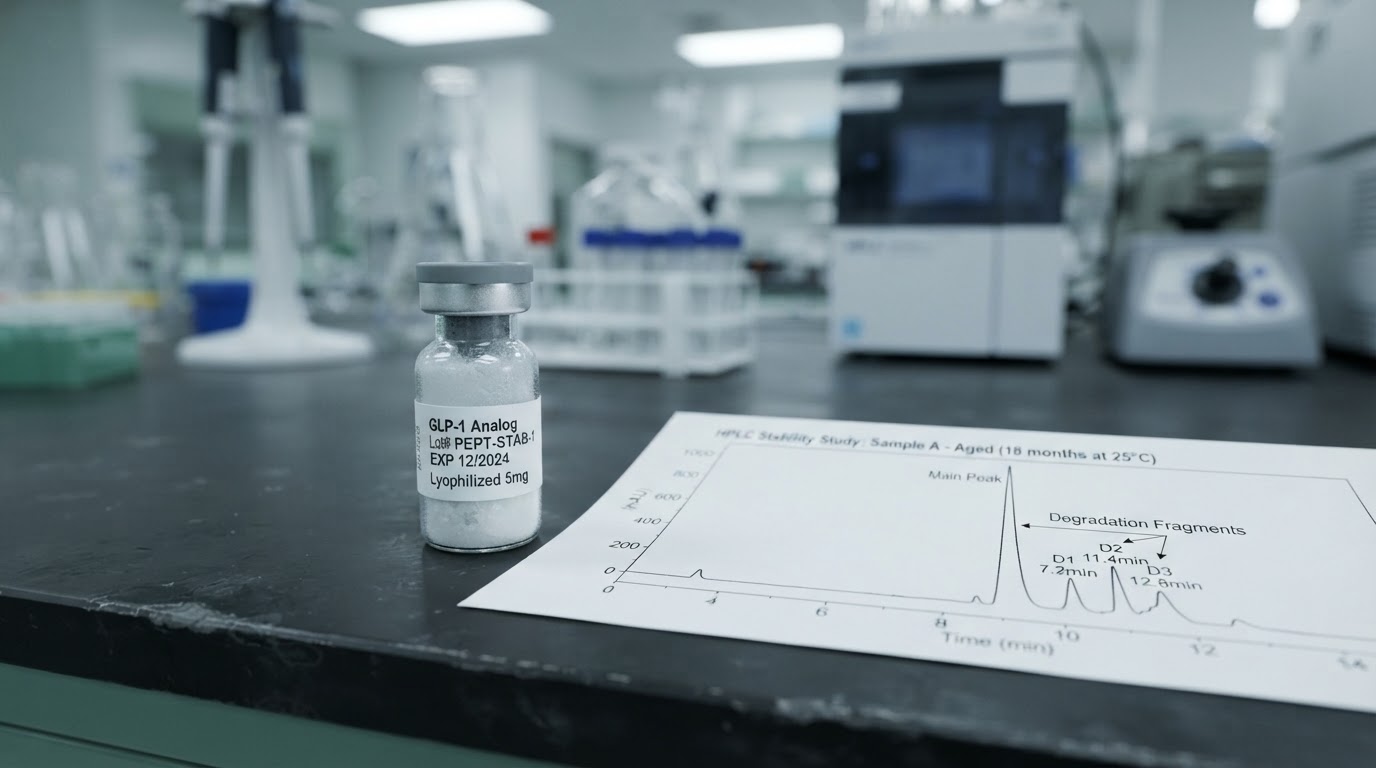 QualityDoes Tirzepatide Expire? Peptide Stability and Retest DatesDoes tirzepatide expire? Yes, peptides degrade over time. Expiry vs retest dates, degradation pathways, and why labs re-test identity and purity.Read moreNovember 202613 min readMetabolicWhen Will Retatrutide Be Available? Status and TimelineWhen will retatrutide be available? It is investigational and unapproved. TRIUMPH phase 3 status, the planned FDA filing, and drug vs reagent, explained.Read moreNovember 202613 min readMetabolicIs Retatrutide a GLP-3? GLP 3 Retatrutide ExplainedIs retatrutide a GLP-3? No. "GLP 3 retatrutide" is a nickname for a triple agonist at the GLP-1, GIP, and glucagon receptors. No GLP-3 receptor exists.Read moreNovember 202612 min readQualityb and y Ions in Peptide Fragmentation: A Worked Guideb and y ions in peptide fragmentation explained: how they form, how to calculate their masses with a worked Selank example, and how to read a MS/MS ladder.Read moreNovember 202611 min readQualityNet Peptide Content vs Purity: What the Percentages MeanNet peptide content vs purity explained: why HPLC purity is not peptide mass, how content is measured by amino acid analysis, and why it affects stocks.Read moreNovember 202611 min readQualityTryptophan Oxidation in Peptides: Kynurenine and MS ShiftsTryptophan oxidation in peptides explained: kynurenine, N-formylkynurenine and hydroxytryptophan, their mass shifts, and how LC-MS tells them apart.Read moreNovember 202611 min readQualityNorleucine Methionine Substitution in Peptides ExplainedNorleucine methionine substitution in peptides explained: why Met oxidizes, what Nle changes, published model studies, and how to spot sulfoxide by MS.Read moreNovember 202612 min readQualityElectrospray Charge States of Peptides: Reading ESI SpectraElectrospray charge states of peptides explained with a kisspeptin-10 example: how to find z, convert m/z to mass, and avoid common ESI mistakes.Read moreNovember 202611 min readQualityMonoisotopic vs Average Mass of Peptides: A Researcher GuideMonoisotopic vs average mass of peptides explained with a MOTS-c worked example: definitions, isotope patterns, charge states and common mix-ups.Read moreNovember 202611 min readQualityPeptide Adsorption to Surfaces: Why Peptides Stick to VialsPeptide adsorption to surfaces explained: how peptides stick to glass and plastic, how much can be lost, and how to test recovery in your own assay.Read moreNovember 202611 min readQualityAib Aminoisobutyric Acid in Peptides: Helix and StabilityAib aminoisobutyric acid in peptides explained: structure, helix promotion, DPP-4 stability design in semaglutide and tirzepatide, and analytical notes.Read moreNovember 202610 min readCellularPepT1 Peptide Transporter: How KPV Enters Cells in ResearchPepT1 peptide transporter explained: how di- and tripeptides such as KPV are taken up, what preclinical studies report, and how to design uptake assays.Read moreNovember 202611 min readCellularKR-12 LL-37 Fragment: Sequence, Structure and ResearchKR-12 LL-37 fragment explained: residues 18-29 of LL-37, how it compares with the full peptide, and what structural studies report. Research use only.Read moreNovember 20269 min readCellularCD38 NAD+ Degradation: How the Enzyme Consumes NAD+CD38 NAD+ degradation explained: what the NADase does, why it is studied in aging models, where the evidence is debated, and assay design points.Read moreNovember 20269 min readQualityProline Cis-Trans Isomerization in Peptides: Why Xaa-Pro Bonds Make Conformers and What That Means for AnalysisProline cis-trans isomerization in peptides explained: why Xaa-Pro bonds form conformers, what the literature shows, and how it affects HPLC reading.Read moreNovember 20269 min readCognitiveSelank vs Tuftsin: Sequence, Origin and Research ComparedSelank vs tuftsin compared: the Thr-Lys-Pro-Arg core, the added Pro-Gly-Pro tail, neuropilin-1 findings and sources. For laboratory research use only.Read moreNovember 20269 min readCellularGlutathione Gamma-Glutamyl Bond: Why GSH Is UnusualThe glutathione gamma-glutamyl bond explained: how GCL forms it, why GGT cleaves it, and how identity is checked in research. Research use only.Read moreNovember 20269 min readQualityPeptide Forced Degradation Studies: Stress Testing ExplainedPeptide forced degradation explained: acid, base, oxidative, thermal and light stress, the pathways it reveals, and why HPLC methods need it.Read moreNovember 202610 min readQualityPyroglutamate Formation in Peptides: N-Terminal Gln and GluPyroglutamate formation in peptides: how N-terminal glutamine and glutamate cyclize, the role of pH and buffer, and how mass spectrometry detects it.Read moreNovember 202610 min readMetabolicTirzepatide Biased Agonism: GIPR and GLP-1R SignalingTirzepatide biased agonism explained: cAMP vs beta-arrestin signaling at the GLP-1 receptor, GIP-like behavior at GIPR, and what in vitro studies report.Read moreNovember 202610 min readGrowthDPP-4 Peptide Cleavage: Which Peptides It Truncates and WhyDPP-4 peptide cleavage explained: the penultimate Ala/Pro rule, GHRH(1-29) and GLP-1 as substrates, and how D-amino acids or N-terminal changes block it.Read moreNovember 202610 min readMetabolicExendin-4 vs GLP-1: Structure, Receptor Binding, OriginExendin-4 vs GLP-1 compared: 39 versus 30 residues, Gila monster venom origin, the Trp-cage fold, a shared GLP-1 receptor, and what the research reports.Read moreNovember 202610 min readQualityAspartimide Formation in Peptides: Causes and PreventionAspartimide formation in peptides explained: why Asp-Gly motifs are at risk in Fmoc synthesis, the by-products it creates, and how it is suppressed.Read moreNovember 20269 min readRecoveryLL-37 Biofilm Research: What Antibiofilm Studies ReportLL-37 biofilm research reviewed: how the cathelicidin peptide has been studied for biofilm prevention, quorum sensing, and synergy, and its limits.Read moreNovember 20269 min readQualityTFA vs Formic Acid in Peptide HPLC: Peak Shape vs MS SignalTFA vs formic acid in peptide HPLC: why TFA sharpens peaks, why formic acid suits mass spectrometry, and what the chromatography literature reports.Read moreNovember 20269 min readGrowthGhrelin Receptor Agonist Peptides: GHSR and IpamorelinGhrelin receptor agonist peptides explained: GHSR structure, acyl-ghrelin, ipamorelin as a pentapeptide mimetic, and what preclinical studies report.Read moreNovember 20269 min readCellularHumanin vs MOTS-c: Two Mitochondrial-Derived PeptidesHumanin vs MOTS-c compared: 16S versus 12S rRNA origin, 24 versus 16 residues, FPR2 versus AMPK-folate signaling, and what preclinical studies report.Read moreNovember 20269 min readQualityPeptide UV Quantification: A205, A214, and A280 ExplainedPeptide UV quantification: when absorbance at 205, 214, or 280 nm works, why short peptides are hard to measure, and the role of amino acid analysis.Read moreNovember 20269 min readQualityEllman Assay for Peptide Thiols: Principle and PitfallsEllman assay for peptide thiols explained: how DTNB quantifies free sulfhydryls, why reactions can be incomplete, and what to check for cysteine peptides.Read moreNovember 20269 min readCellularProthymosin Alpha vs Thymosin Alpha 1: Precursor vs FragmentProthymosin alpha vs thymosin alpha 1 explained: how the larger nuclear protein relates to its 28-residue fragment, and what each is studied for.Read moreNovember 20269 min readCellularCopper-Binding Peptides: GHK-Cu and the ATCUN MotifCopper-binding peptides explained: how GHK-Cu, DAHK, and ATCUN motifs coordinate Cu(II), why redox behavior differs, and what to consider in assay design.Read moreNovember 20269 min readCellularSS-31 and Cardiolipin: How the Peptide Binds MembranesSS-31 cardiolipin research explained: how the tetrapeptide binds the anionic lipid of the inner mitochondrial membrane and what it means for assay design.Read moreNovember 20269 min readGrowthGH-IGF-1 Axis: How GHRH, Ghrelin, and IGF-1 InteractThe GH-IGF-1 axis explained: how GHRH, somatostatin, and ghrelin control GH release, how IGF-1 feeds back, and where peptide research tools fit in.Read moreNovember 20269 min readMetabolicGlucagon Receptor Agonist Peptides: Research OverviewGlucagon receptor agonist peptides explained: what GCGR does, why it pairs with GLP-1 agonism, and how retatrutide and other co-agonists are studied.Read moreNovember 20269 min readCellularGSH vs GSSG: Reduced and Oxidized Glutathione ExplainedGSH vs GSSG explained: how reduced and oxidized glutathione differ, what the GSH:GSSG ratio indicates, and why it is hard to measure in research.Read moreNovember 20269 min readCellularNAD+ vs NADH: Oxidized and Reduced Forms ExplainedNAD+ vs NADH explained: how the oxidized and reduced forms of the same coenzyme differ, what the NAD+/NADH ratio measures, and why measurement is hard.Read moreNovember 20269 min readQualityPeptide Impurities: Types, Origins, and How Labs Find ThemPeptide impurities explained: deletion, insertion, racemized, oxidized, and degraded species, where they come from, and how HPLC and MS detect them.Read moreNovember 20269 min readCellularNAMPT vs NNMT: Two Enzymes That Decide Nicotinamide's FateNAMPT vs NNMT explained: how one enzyme recycles nicotinamide into NAD+ while the other methylates it using SAM, and what research says about each.Read moreNovember 20269 min readMetabolicOxyntomodulin Peptide: The Proglucagon Hormone ExplainedOxyntomodulin peptide research: the proglucagon-derived gut hormone that activates GLP-1 and glucagon receptors, and its link to retatrutide.Read moreNovember 20269 min readMetabolicGIP vs GLP-1: Two Incretin Hormones and Their ReceptorsGIP vs GLP-1 explained: how the two incretin hormones and receptors differ, why dual agonists like tirzepatide target both, and what research shows.Read moreNovember 20269 min readRecoveryBPC-157 Sequence: GEPPPGKPADDAGLV and Its ChemistryBPC-157 sequence explained: the 15-residue GEPPPGKPADDAGLV pentadecapeptide, its proline-rich composition, mass, stability data, and how labs verify it.Read moreNovember 20269 min readCellularGHK-Cu vs GHK: Copper Complex vs Free TripeptideGHK-Cu vs GHK explained: how the copper(II) complex differs from the free glycyl-histidyl-lysine tripeptide in chemistry, speciation, and research.Read moreNovember 20269 min readGrowthCJC-1295 No DAC vs Sermorelin: GHRH(1-29) AnalogsCJC-1295 no DAC vs sermorelin compared: two GHRH(1-29) analogs that differ by stabilizing substitutions, with published stability and degradation research.Read moreNovember 20269 min readCognitiveOxytocin vs Vasopressin: Two Nonapeptides, Four ReceptorsOxytocin vs vasopressin compared: two nonapeptides that differ at only two residues yet act on distinct but cross-reactive G protein-coupled receptors.Read moreNovember 20269 min readHealthy AgingPT-141 vs Melanotan 2: Structure and Receptor ResearchPT-141 vs Melanotan 2 compared: how bremelanotide and MT-II share one cyclic heptapeptide ring but differ at the C-terminus, and what research reports.Read moreNovember 20269 min readCellularLL-37 vs hCAP18: Active Peptide vs Cathelicidin PrecursorLL-37 vs hCAP18 explained: how the ~19 kDa precursor stored in neutrophil granules is cleaved into the active LL-37 peptide, and why they differ.Read moreNovember 20269 min readMetabolicSemaglutide vs Liraglutide: Two Acylated GLP-1 AnaloguesSemaglutide vs liraglutide compared: how two albumin-binding GLP-1 analogues differ in structure, receptor affinity, and published head-to-head trials.Read moreNovember 202610 min readGrowthKisspeptin-10 vs Kisspeptin-54: Isoforms ComparedKisspeptin-10 vs kisspeptin-54 compared: how the two KISS1 isoforms differ in length, receptor activity, half-life, and published human physiology data.Read moreNovember 20269 min readCellularThymosin Alpha 1 vs Thymosin Beta 4: Two Thymic PeptidesThymosin alpha 1 vs thymosin beta 4 compared: sequence length, origin, actin binding versus Toll-like receptor signaling, and what each literature reports.Read moreNovember 20269 min readHealthy AgingEpithalon vs Epithalamin: Tetrapeptide vs Pineal ExtractEpithalon vs epithalamin explained: a synthetic AEDG tetrapeptide versus the pineal-derived preparation it was modeled on, and what each reports.Read moreNovember 20269 min readGrowthIpamorelin vs GHRP-6: Selectivity and StructureIpamorelin vs GHRP-6 compared: two growth hormone-releasing peptides, their sequences, shared receptor pathway, and reported selectivity differences.Read moreNovember 20269 min readCellularGlutathione vs NAC: Tripeptide and Cysteine ProdrugGlutathione vs NAC compared: the endogenous gamma-glutamyl tripeptide and its cysteine-derived relative, their chemistry, and research on mechanism.Read moreNovember 20268 min readRecoveryARA-290 vs Erythropoietin: Peptide Mimic and ParentARA-290 vs erythropoietin compared: an 11-residue helix B peptide and the 166-residue EPO protein, their receptors, and preclinical findings.Read moreNovember 202610 min readMetabolicSemaglutide Half-Life: Why It Lasts About a WeekSemaglutide half-life explained: how an Aib8 swap, an Arg34 change, and a C18 di-acid albumin tag extend a roughly 1-week half-life from GLP-1's minutes.Read moreNovember 20268 min readCellularSS-31 vs MOTS-c: Two Mitochondrial PeptidesSS-31 vs MOTS-c compared: a synthetic cardiolipin-binding tetrapeptide versus an endogenous mitochondrial-derived peptide, by origin and target.Read moreNovember 20268 min readCellularKPV vs Alpha-MSH: A Tripeptide and Its ParentKPV vs alpha-MSH compared: a 13-residue melanocortin hormone versus its C-terminal Lys-Pro-Val tripeptide, their sequences, receptors, and research roles.Read moreNovember 20268 min readGrowthIGF-1 LR3 vs IGF-1: Structure and Binding ComparedIGF-1 LR3 vs IGF-1 compared: the 13-residue extension, the Glu3-to-Arg swap, reduced IGF-binding protein affinity, and what that means in lab models.Read moreNovember 20269 min readMetabolicAOD-9604 vs HGH Fragment 176-191: Sequences ComparedAOD-9604 vs HGH fragment 176-191 compared: native hGH residues, the added N-terminal tyrosine, the shared disulfide loop, and how labs confirm identity.Read moreNovember 20269 min readMetabolicIncretin Peptides: GLP-1, GIP, and GlucagonIncretin peptides explained: GLP-1, GIP, and glucagon as peptide hormones, their receptors, and how mono, dual, and triple agonists map onto them.Read moreNovember 20269 min readCellularKisspeptin vs GnRH: Two Reproductive PeptidesKisspeptin vs GnRH compared: an upstream KISS1R ligand versus the decapeptide that drives the pituitary, their sequences, receptors, and research roles.Read moreNovember 20269 min readCellularNAD+ vs NMN: Coenzyme and Precursor ComparedNAD+ vs NMN compared: a redox coenzyme versus its nucleotide precursor, how the salvage pathway links them, and how laboratories tell the two apart.Read moreNovember 20269 min readCognitiveSemax Peptide Structure: Sequence and ResearchSemax peptide structure: the ACTH(4-7) analog Met-Glu-His-Phe-Pro-Gly-Pro, its Pro-Gly-Pro tail, and what published gene-expression studies report.Read moreNovember 20269 min readGrowthSermorelin vs Tesamorelin: GHRH Analogs ComparedSermorelin vs tesamorelin compared: a 29-residue GHRH fragment versus a hexenoyl-modified 44-residue analog, and how DPP-IV stability separates them.Read moreNovember 20269 min readLongevityThymic Peptides: Thymosin, Thymulin, and ResearchWhat are thymic peptides? Thymosin fraction 5, thymosin alpha 1, thymosin beta 4, thymulin, and thymopoietin, and how laboratories confirm each sequence.Read moreNovember 20269 min readLongevityPeptide Bioregulators: Khavinson Short Peptides ResearchWhat are peptide bioregulators? Khavinson's short peptides, how Epithalon (AEDG) fits, and what the gene-expression research actually shows.Read moreNovember 20269 min readCellularMitochondrial-Derived Peptides: MOTS-c and HumaninWhat are mitochondrial-derived peptides? How MOTS-c and humanin are encoded in mtDNA, and what research reports about AMPK and apoptosis in cells.Read moreNovember 202610 min readHealthy AgingMelanocortin Peptides: Receptors, Analogs, and ResearchWhat are melanocortin peptides? POMC-derived α-MSH and ACTH, the five MC receptors, and how MT-I, MT-II, PT-141, and KPV fit into receptor research.Read moreNovember 202610 min readHealthy AgingCosmetic Peptides: Classes, Examples, and ResearchWhat are cosmetic peptides? Signal, carrier, neurotransmitter-inhibiting, and enzyme-inhibiting classes, with GHK-Cu and SNAP-8 as research examples.Read moreNovember 202610 min readCellularGlutathione Stability: Solution Chemistry and AssaysGlutathione stability in solution: copper-catalyzed oxidation, HPLC comparisons, cyclodextrin complexation, and artifact-aware GSH/GSSG assays.Read moreNovember 20268 min readCognitiveSelank Structure: Sequence, Tuftsin, and ResearchSelank structure: the tuftsin heptapeptide Thr-Lys-Pro-Arg-Pro-Gly-Pro, its Pro-Gly-Pro tail, and what published gene-expression studies report.Read moreNovember 20268 min readRecoveryBPC-157 vs TB-500: Structures ComparedBPC-157 vs TB-500 compared: a gastric pentadecapeptide versus a synthetic thymosin β4 fragment, and how laboratories tell the two sequences apart.Read moreNovember 20268 min readHealthy AgingMelanotan 2 Peptide: Cyclic Lactam StructureWhat is melanotan 2 peptide? The cyclic lactam α-MSH analog MT-II, how it differs from linear Melanotan-I, and what structure–activity studies report.Read moreNovember 20268 min readHealthy AgingPT-141 Peptide: Structure and Receptor ResearchWhat is PT-141 peptide? A cyclic melanocortin heptapeptide related to Melanotan-II, its receptor-research context, and how laboratories confirm identity.Read moreNovember 20269 min readEducationPeptide Nomenclature: Codes, Sequence Notation, and RulesWhat is peptide nomenclature? IUPAC rules for naming peptides, three- and one-letter codes, terminal and D-residue notation, and fragment ion labels.Read moreNovember 202610 min readEducationPeptide Hydrogen Bonding: Backbone, Side Chains, EnergyWhat is peptide hydrogen bonding? Learn which groups donate and accept, how H-bond patterns build helices, sheets, and turns, and how they are measured.Read moreNovember 202610 min read
 EducationBeta Turns in Peptides: Types, Geometry, and SequenceWhat are beta turns? How four residues reverse a peptide chain, how types I, II, I', II' and VIII differ, which residues favor them, and how they're found.Read moreNovember 202611 min readQualityAmino Acid Analysis: Hydrolysis, Derivatization, and HPLCWhat is amino acid analysis? How peptides are hydrolyzed, derivatized, and quantified by HPLC, which residues need special care, and what the data show.Read moreNovember 202610 min readHealthy AgingMelanotan 1 Peptide: Structure and MC1R ResearchWhat is melanotan 1 peptide? NDP-MSH structure, MC1R research, and how Melanotan-I differs from native alpha-MSH in the published literature.Read moreNovember 202610 min readGrowthCJC-1295 No DAC: Modified GRF Structure ResearchWhat is CJC-1295 No DAC? How modified GRF(1-29) differs from albumin-binding CJC-1295, its substitutions, and published GHRH research context.Read moreNovember 20269 min readHealthy AgingKLOW 80 Peptide: Four-Component Blend ResearchWhat is KLOW 80 peptide? How the 80 mg research blend adds KPV to GHK-Cu, BPC-157, and TB-500, and what published component literature reports.Read moreNovember 20269 min readHealthy AgingGLOW 70 Peptide: Blend Composition and ResearchWhat is GLOW 70 peptide? How the 70 mg research blend is typically composed, why mass ratios matter, and how labs read a blend COA carefully.Read moreNovember 20269 min readRecoveryWolverine Blend Peptide: Dual-Peptide ResearchWhat is wolverine blend peptide? Dual-peptide recovery formulations, BPC-157 and TB-500 research context, and how labs document 5/5 MG vials.Read moreNovember 20269 min readCognitiveOxytocin Peptide: Structure, Receptor, and ResearchWhat is the oxytocin peptide? Its nine-residue structure, disulfide ring, receptor signaling, how it differs from vasopressin, and what research reports.Read moreNovember 202612 min readHealthy AgingSNAP-8 Peptide: Structure, SNARE Biology, and ResearchWhat is SNAP-8 peptide? The acetyl octapeptide-3 sequence, its SNAP-25 origin, how it compares with argireline, and what SNARE research shows.Read moreNovember 202611 min readEducationPeptide Lipidation: Fatty Acid Acylation ExplainedWhat is peptide lipidation? How fatty acid acylation, linker design, and reversible albumin binding extend peptide half-life in published research.Read moreNovember 202612 min readEducationD-Amino Acid Peptides: Chemistry and DetectionWhat are d-amino acid peptides? How intentional D residues, natural DAACPs, mirror-image designs, and analytics differ from accidental racemization.Read moreNovember 202613 min readEducationPeptide Phosphorylation: Kinases, Sites, and DetectionWhat is peptide phosphorylation? How kinases tag serine, threonine, and tyrosine, how phosphopeptides are enriched, and how mass spec locates each site.Read moreNovember 202612 min readEducationStapled Peptides: Hydrocarbon Staples and HelicesWhat are stapled peptides? How all-hydrocarbon staples are made by ring-closing metathesis, how they constrain an alpha-helix, and what research shows.Read moreNovember 202611 min readEducationPeptide Glycosylation: N-Linked and O-Linked GlycansWhat is peptide glycosylation? How N-linked and O-linked glycans are attached, how often it occurs, what it changes chemically, and how it is detected.Read moreNovember 202611 min readEducationPeptide Sequencing: Edman Degradation and Tandem MSHow does peptide sequencing work? Compare Edman degradation, tandem mass spectrometry, database searching, and de novo sequencing of peptides and proteins.Read moreNovember 202610 min readEducationPeptide Conjugation: Linker Chemistry and MethodsWhat is peptide conjugation? A guide to native chemical ligation, maleimide-thiol coupling, click chemistry, and PEG-peptide conjugate chemistry.Read moreNovember 202611 min readEducationPeptide Library: Phage Display, SPOT, and Split-PoolWhat is a peptide library? How phage display, split-and-pool synthesis, one-bead-one-compound beads, and SPOT arrays build and screen peptide collections.Read moreNovember 202612 min read
Browse the Journal by Topic
Journal articles are long-form, sourced overviews written for a laboratory research audience. If you're looking for something specific, these groupings may be faster than scrolling.
Foundations. Start with A Beginner's Guide to Peptides, then see how research peptides are made in Solid Phase Peptide Synthesis and Peptide Lyophilization. For how peptides cross cell membranes, see Cell Penetrating Peptides, and for the sulfur cross-links that hold many peptides in shape, see Disulfide Bonds in Peptides. For the acetyl cap many proteins and peptides carry at their starting end, see N-Terminal Acetylation. For how pKa values set a peptide’s net charge and how to estimate its isoelectric point, see Peptide Isoelectric Point. For what sequence, charge, and pH control in solution, see Peptide Solubility. For the local backbone folds that define peptide secondary structure, see Peptide Secondary Structure.
Quality and testing. Why Peptide Purity Matters covers impurity types. What 99% Purity Really Means and Peptide Testing Explained show how to read HPLC, mass spectrometry, and COA results. How Long Do Peptides Last? covers stability, and Peptide Oxidation covers the oxidation degradation pathway. For how crude peptide is isolated into a defined lot, see Peptide Purification. For how the acetate counterion compares with TFA and HCl, see Acetate Salt Peptide. For how L-to-D epimerization creates diastereomer impurities during synthesis, see Peptide Racemization.
Research-area overviews. Understanding Metabolic Peptide Research, The Emerging Science of Healthy Aging, and Growth Hormone Secretagogues each survey a whole category.
Single-compound deep dives. BPC-157, LL-37, KPV, ARA-290, GHK-Cu, Epithalon, Thymosin Alpha 1, MOTS-c, SS-31, and DSIP.
Comparisons. TB-500 vs. Thymosin Beta-4 and Semax vs Selank.
For shorter primers, see Educational Resources. For single-question explanations, see Research Peptide Answers. To browse compounds by area, go to Research Areas.
FAQ
Are Journal articles guidance for human use?
No. Articles summarize published research literature for laboratory research context only. BioAura products are for research use only.