
Does Tirzepatide Expire? Stability, Expiry and Retest Dates for a Research Peptide
Does tirzepatide expire? Yes, peptides degrade over time. Expiry vs retest dates, degradation pathways, and why labs re-test identity and purity.
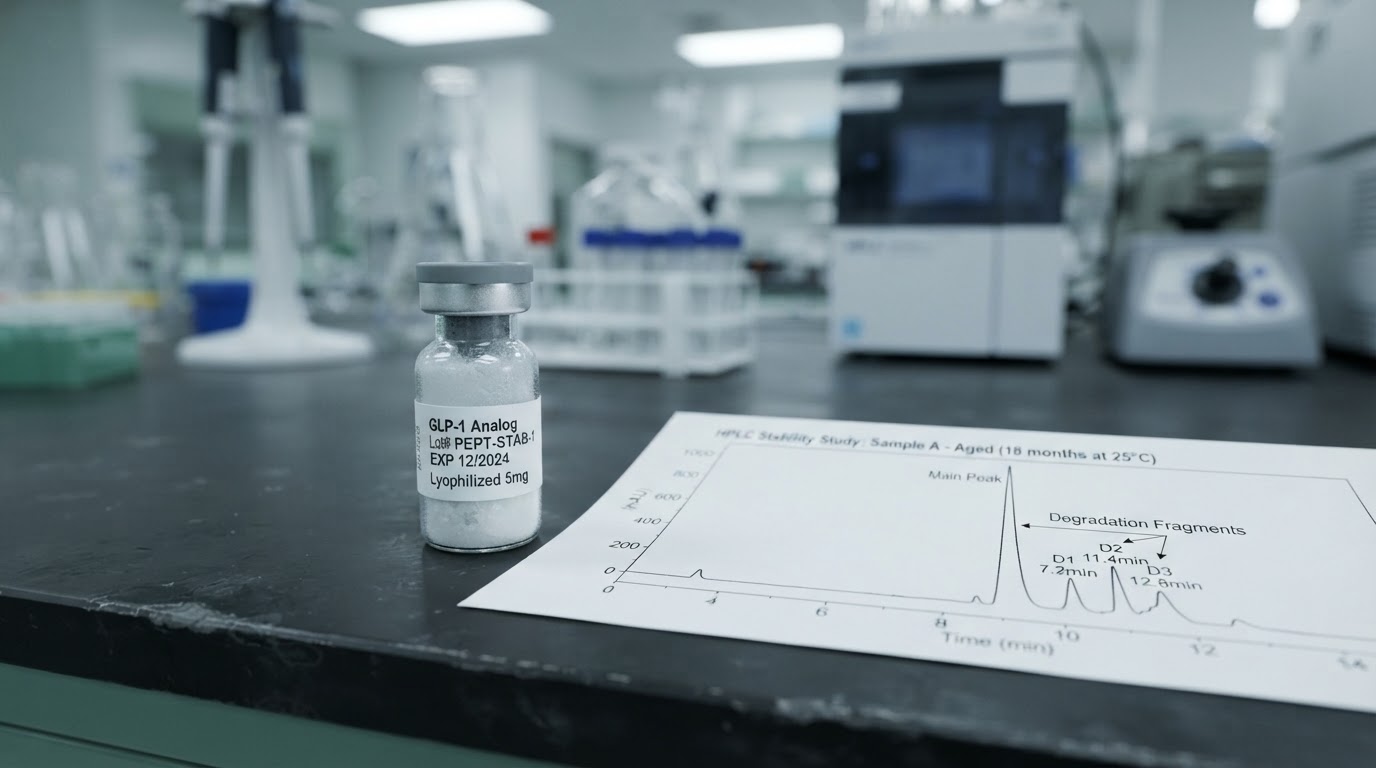
How a lipidated research peptide degrades over time, what an expiry or retest date actually certifies, and why identity and purity are checked again after storage.
Yes. Like any peptide, tirzepatide degrades over time, so a research lot carries a date tied to defined storage conditions. Before that date the material is expected to meet its specification; after it, that expectation no longer holds. Labs should re-test identity and purity by HPLC and mass spectrometry before using older material.
Last reviewed: October 2026
"Does tirzepatide expire" is a reasonable question for any lab that holds peptide stock for months at a time. The answer has less to do with tirzepatide specifically than with how peptides behave as chemicals: they hydrolyze, deamidate, oxidize, and aggregate, more slowly in a dry solid and faster in solution. This article explains what an expiry or retest date means under international quality guidelines, which degradation pathways are relevant to a fatty acid modified peptide, and how analytical testing shows whether a stored lot is still what its label says. It covers laboratory reagents only. It gives no guidance on human use of any tirzepatide product, expired or otherwise.
Tirzepatide expiration at a glance
| Question | Short answer |
|---|---|
| Does tirzepatide expire? | Yes. Any peptide degrades over time; the lot date marks how long it is expected to stay within specification |
| What the date depends on | Real-time stability data under defined storage conditions [1][3] |
| Expiry date | After this date the material should not be used [2] |
| Retest date | The date when material should be re-examined for suitability [2] |
| Main chemical risks | Hydrolysis, deamidation, oxidation, aggregation, fragmentation [3][4] |
| How to check a stored lot | Stability-indicating HPLC for purity, mass spectrometry for identity [3][7] |
Does tirzepatide expire?
Yes. Tirzepatide is a peptide, and every peptide changes chemically over time, so research material is given a date beyond which its quality is no longer assured. The date is not arbitrary: it is supposed to reflect stability data gathered under specified storage conditions.
Tirzepatide (LY3298176) was described in its discovery paper as "a fatty acid modified peptide with dual GIP and GLP-1 receptor agonist activity" [6]. That structure, a peptide backbone with a lipid modification, has the same vulnerabilities as other peptides: bonds that can hydrolyze, side chains that can deamidate or oxidize, and a tendency for molecules to associate into aggregates. For the molecule's design and receptor pharmacology, see our tirzepatide research overview.
The ICH stability guideline Q1A(R2) states that the purpose of stability testing is to show how the quality of a substance "varies with time under the influence of a variety of environmental factors such as temperature, humidity, and light," and to establish "a re-test period for the drug substance or a shelf life for the drug product and recommended storage conditions" [1]. Research reagents are not regulated drug substances, but the same logic applies: a date only means something when it is linked to data and to storage conditions.
What is the difference between an expiry date and a retest date?
An expiry date marks when material should no longer be used; a retest date marks when material should be re-examined to confirm it is still suitable. The two terms come from pharmaceutical quality guidelines and are often confused.
| Term | Definition (source) | Practical meaning for a lab |
|---|---|---|
| Expiry (expiration) date | The date during which material "is expected to remain within established shelf life specifications if stored under defined conditions, and after which it should not be used" [2] | Treat as the end of usable life |
| Retest date | "The date when a material should be re-examined to ensure that it is still suitable for use" [2] | Test again before further use |
| Re-test period | The period during which a substance "is expected to remain within its specification" when stored under defined conditions [1] | Expected window of stability |
| Shelf life | The period a product is expected to stay within specification, "provided that it is stored under the conditions defined on the container label" [1] | Also called the expiration dating period |
ICH Q1A(R2) adds an important nuance: "For most biotechnological/biological substances known to be labile, it is more appropriate to establish a shelf life than a re-test period" [1]. In plain terms, the more fragile a molecule, the more a fixed end date makes sense. Peptides sit between small molecules and proteins, so practice varies by supplier; what matters is that the date is backed by data.
Why do peptides like tirzepatide degrade?
Peptides degrade through chemical reactions, such as hydrolysis, deamidation, and oxidation, and through physical changes, such as aggregation. These pathways can lower purity, create new impurities, and alter the molecule's behaviour in an assay.
The ICH guideline on biotechnological products, Q5C, lists the degradation changes that stability methods should detect: changes "that may result from deamidation, oxidation, sulfoxidation, aggregation or fragmentation during storage" [3]. Manning and colleagues' review of protein pharmaceutical stability covers the same ground, discussing both "chemical and physical instability" and how stabilization differs "in aqueous solution and the dried state" [4].
- Hydrolysis and fragmentation. Water can cleave peptide bonds, producing shorter fragments.
- Deamidation. Asparagine and glutamine side chains can lose ammonia, changing charge and mass. See our article on peptide deamidation.
- Oxidation. Susceptible residues such as methionine and tryptophan can be oxidized, adding mass.
- Aggregation. Molecules can associate non-covalently or covalently, which can reduce the amount of free, monomeric peptide.
A 2026 analytical study developed a stability-indicating HPLC method for tirzepatide and semaglutide and tested it under "acidic and basic hydrolysis, oxidative, and photolytic degradation," quantifying each peptide "without interference from degradants" [7]. That is a direct demonstration that tirzepatide forms measurable degradation products under stress. For how labs use stress testing to map these pathways, see peptide forced degradation studies.
Does lyophilized tirzepatide last longer than a solution?
In general, yes: removing water by freeze-drying slows many of the reactions that degrade peptides. That is why research peptides are usually supplied as a lyophilized powder.
Izutsu's review of freeze-drying notes that solidification "significantly improves storage stability of proteins, peptides, antibiotics, vaccines, and liposomes, which are marginally stable in aqueous solutions," and that some excipients embed active ingredients "in glass-state solids with low molecular mobility, thereby reducing chemical reactivity" [5]. Water is a reactant in hydrolysis and enables deamidation, so a dry solid generally gives these reactions less to work with.
Lyophilization does not stop degradation entirely, however. ICH Q5C notes that moisture level is a relevant stability parameter for "powders and lyophilised products" [3]. Exposure to humidity, light, and heat all shorten the period over which a lot stays within specification. Rather than repeat storage instructions here, we keep them in one place: see our peptide storage guide.
What happens to tirzepatide after its expiry date?
After its expiry or retest date, a tirzepatide lot is no longer covered by its specification, so its purity and identity can no longer be assumed. The material may still be largely intact, or it may have degraded; only testing can show which.
From a research perspective, the risk is not a dramatic change at midnight on the label date. It is uncertainty. A lot that has drifted from its original purity can introduce variables into an experiment:
- Lower effective concentration of intact peptide, if part of the material has degraded.
- New impurities, such as deamidated, oxidized, or truncated species, that may have their own activity or interfere with an assay.
- Aggregates, which can change solubility and how the material behaves in solution.
Each of these can make results harder to interpret or reproduce. For that reason, labs typically either retire material at its expiry date or, for material with a retest date, re-test it against specification before further use. This applies to research reagents only; BioAura provides no guidance on human or veterinary use of any product.
Why re-test identity and purity after storage?
Because a stability-indicating method can show whether degradation products have appeared, and mass spectrometry can confirm the main component is still the expected molecule. Re-testing turns an assumption into data.
ICH Q5C states that, for stability testing, "tests for purity should focus on methods for determination of degradation products" [3]. A stability-indicating HPLC method is designed to separate the intact peptide from its degradants, as the 2026 tirzepatide method was validated to do [7]. Mass spectrometry adds an identity check: deamidation, oxidation, and truncation each produce characteristic mass shifts relative to the expected molecule. For a walkthrough of both techniques, see how peptide testing works.
Comparing a re-test result with the original certificate of analysis for the same lot shows whether anything has changed. Our tirzepatide research peptide is manufactured in the USA and ships with a batch-specific certificate of analysis showing HPLC purity above 99% and mass spectrometry identity confirmation. For a section-by-section explanation of those documents, see how to read a COA.
Key Takeaways
- Tirzepatide is a fatty acid modified peptide, and like all peptides it degrades over time.
- An expiry date marks the end of usable life; a retest date marks when material should be re-examined.
- Any date is only meaningful when tied to stability data and defined storage conditions.
- Relevant degradation pathways include hydrolysis, deamidation, oxidation, aggregation, and fragmentation.
- Lyophilized powder generally degrades more slowly than solution, but moisture, light, and heat still matter.
- Stability-indicating HPLC and mass spectrometry are how a lab confirms a stored lot still meets specification.
Frequently Asked Questions
Does tirzepatide expire?
Yes. Tirzepatide is a peptide, and peptides degrade over time through reactions such as hydrolysis, deamidation, and oxidation, as well as aggregation. Research lots therefore carry an expiry or retest date that should be based on stability data under defined storage conditions. After that date, the lot's purity and identity are no longer assured without re-testing.
What happens if a lab uses expired tirzepatide?
The lab loses assurance that the material meets its specification. It may contain less intact peptide, new impurities such as deamidated or oxidized species, or aggregates, any of which can confound results. Good practice is to retire expired material or re-test it. BioAura provides no guidance on human or veterinary use of any product.
What is the difference between an expiry date and a retest date?
Under ICH Q7, an expiry date is the date after which material should not be used, and a retest date is the date when material should be re-examined to confirm it is still suitable. ICH Q1A(R2) notes that for labile biological substances, a fixed shelf life is usually more appropriate than a re-test period.
Does lyophilized tirzepatide last longer than tirzepatide in solution?
Generally, yes. Freeze-drying removes water, which takes part in hydrolysis and enables deamidation, and a review of freeze-drying notes it significantly improves the storage stability of peptides that are only marginally stable in solution. Moisture, light, and heat can still degrade a lyophilized powder, so storage conditions remain important.
How can a lab check whether stored tirzepatide is still good?
By re-testing. A stability-indicating HPLC method separates intact tirzepatide from degradation products to measure purity, and mass spectrometry confirms identity and reveals mass shifts from changes such as oxidation or deamidation. Comparing those results with the lot's original certificate of analysis shows whether the material has changed during storage.
How does tirzepatide work at the receptor level?
Tirzepatide, also known as LY3298176, is a fatty acid modified peptide that activates both the GIP receptor and the GLP-1 receptor. Its discovery paper reported that it activated both receptors' signaling in vitro. Degradation can alter the intact peptide content of a lot, which is one reason receptor assays depend on well-characterized material.
Research & Sources
- International Council for Harmonisation. ICH Q1A(R2): Stability Testing of New Drug Substances and Products. Step 4 version, February 6, 2003. https://database.ich.org/sites/default/files/Q1A%28R2%29%20Guideline.pdf
- International Council for Harmonisation. ICH Q7: Good Manufacturing Practice Guide for Active Pharmaceutical Ingredients. Step 4 version, November 10, 2000. https://database.ich.org/sites/default/files/Q7%20Guideline.pdf
- International Council for Harmonisation. ICH Q5C: Quality of Biotechnological Products: Stability Testing of Biotechnological/Biological Products. Step 4 version, November 30, 1995. https://database.ich.org/sites/default/files/Q5C%20Guideline.pdf
- Manning MC, Chou DK, Murphy BM, Payne RW, Katayama DS. Stability of protein pharmaceuticals: an update. Pharm Res. 2010;27(4):544–575. doi:10.1007/s11095-009-0045-6. https://pubmed.ncbi.nlm.nih.gov/20143256/
- Izutsu KI. Applications of freezing and freeze-drying in pharmaceutical formulations. Adv Exp Med Biol. 2018;1081:371–383. doi:10.1007/978-981-13-1244-1_20. https://pubmed.ncbi.nlm.nih.gov/30288720/
- Coskun T, Sloop KW, Loghin C, et al. LY3298176, a novel dual GIP and GLP-1 receptor agonist for the treatment of type 2 diabetes mellitus: From discovery to clinical proof of concept. Mol Metab. 2018;18:3–14. doi:10.1016/j.molmet.2018.09.009. https://pubmed.ncbi.nlm.nih.gov/30473097/
- Khalil HA, Hassanein NA, El-Yazbi AF, Mahgoub H. A multimodal HPLC stability indicating approach for the estimation of semaglutide and tirzepatide in bulk, pharmaceutical dosage forms, and rat plasma: a six-edged sustainability appraisal. BMC Chem.2026;20(1):31. doi:10.1186/s13065-025-01716-7. https://pmc.ncbi.nlm.nih.gov/articles/PMC12918740/
All BioAura products are sold strictly for laboratory research use only. They are not intended for human or veterinary use, diagnosis, or treatment. See our Research Use Policy.